
what i’m teaching this month: pistol squat
pistol squat is a humbling pose.
it looks simple enough from the outside. one leg bends, one leg reaches forward, you lower down, you stand back up. casual, right?
not exactly.
pistol squat asks for a lot at once: ankle mobility, hip stability, core control, lower-body strength, balance, and the ability to stay steady while moving through a deep single-leg shape. it is not just about being “strong enough.” your proportions matter. your ankles matter. your hips matter. your center of gravity matters.
some bodies drop right into it like it’s their full-time job, and some bodies are like “….?”
and honestly, i get it.
i don’t usually love teaching things i can’t personally do in the full expression. not because i think teachers need to perform every pose perfectly, but because i want to understand what i’m asking of people. i want to know the pathway, the sticking points, and the places where a little support can completely change the experience.
with pistol squat, i know the framework. i know what it asks for, and i know where it can get tricky. i also know that for my own body, a block under my heel makes the pose feel much more accessible. sometimes i’ll use a strap around my foot to help create balance and support. the full expression is not something i casually drop into on command, and i’m fine saying that.
that’s part of why i wanted to teach toward it.
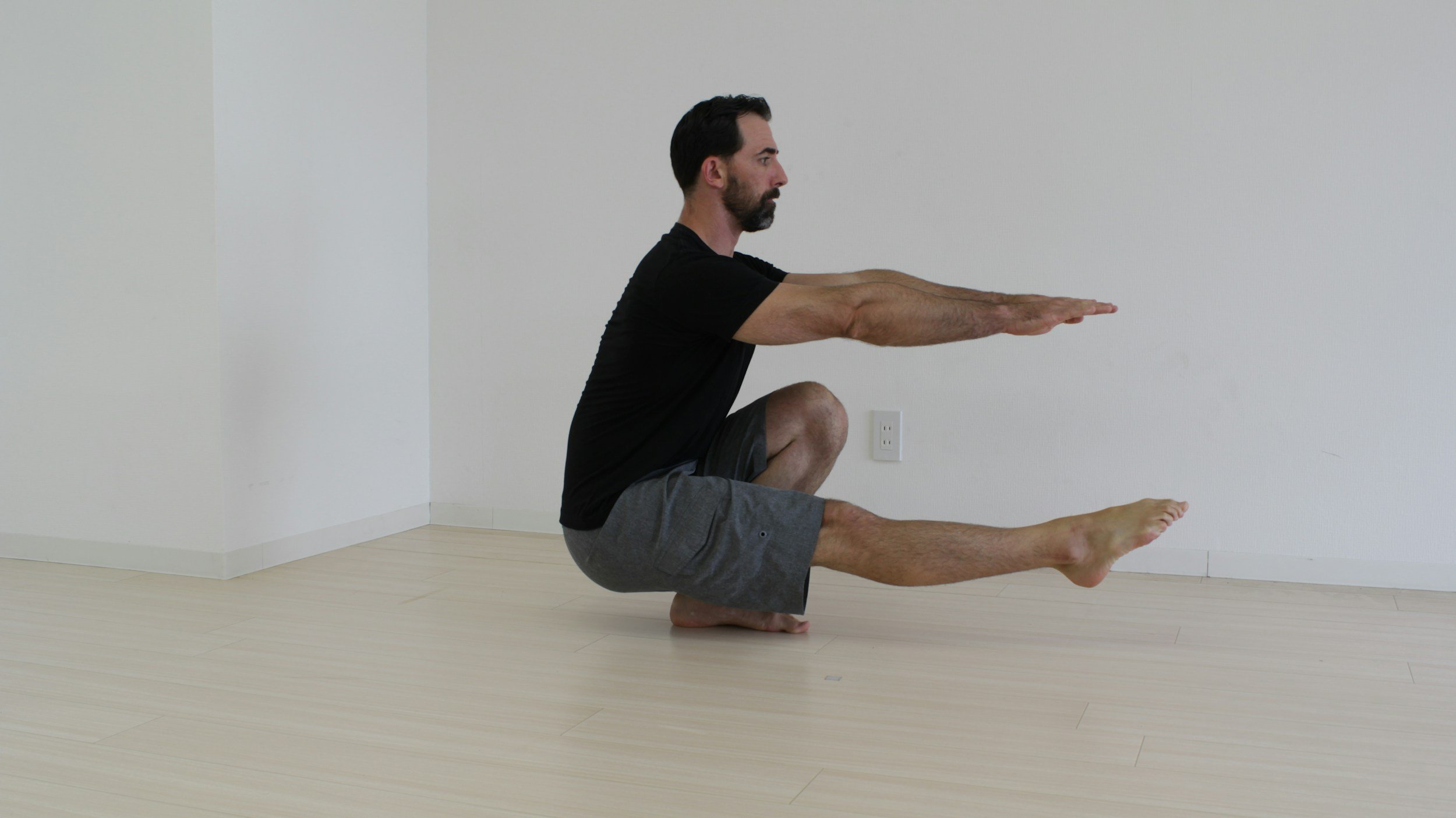
and in case you need a refresher on what a full pistol squat looks like, see my google image model below. enjoy!
the mechanics
pistol squat asks the body to stay organized while moving through a deep single-leg shape. the standing foot stays grounded, the knee tracks in line with the toes, and the hips sit back and down with control. the chest may lean slightly forward to help with balance, but the core stays engaged so the spine doesn’t completely collapse into the shape.
the lifted leg reaches forward, but it does not have to be perfectly straight. the arms can reach forward, hold blocks, or work with a strap (or sweat towel) around the foot for support and to counterbalance. and if the standing heel wants to lift, placing a block or wedge underneath it can help make the pose more accessible by giving the ankle more support.
more than anything, the pose asks for control over depth. it’s not about dropping as low as possible. it’s about finding a version where the standing leg feels strong, the knee feels supported, and the body can move with steadiness instead of force.
one thing i made an effort doing for this flow was making sure students brought two blocks into the room, because props are not a downgrade. they are a beautiful tool. they help us feel the pose, access the work, and meet the body where it actually is instead of where our ego thinks it should be.
final thoughts
what i love about this sequence is that there are so many places to feel strong before we ever get to the peak. maybe the pistol squat itself doesn’t happen. maybe it’s not even close. but maybe your single-leg chair feels more stable. maybe your standing figure four feels stronger. maybe your balance holds for one extra breath. maybe you realize your legs are doing way more than you give them credit for.
that’s the point.
i don’t want students to leave class feeling like they either “got” the pose or failed. yoga is not a checklist, and pistol squat is not the final exam. it’s just a really interesting way to explore strength, mobility, patience, and the slightly unhinged experience of trying to balance on one leg so close to the ground.
i made this flow in less than a day, which is funny because sometimes the sequences i overthink the least end up being the ones i love the most. this one feels creative, strong, playful, and honest. it gives people options. it gives people challenge. and it gives everyone a chance to find their own version of the work.
so for the next month, we’ll be hanging out with pistol squat. we’ll use blocks. we’ll wobble. we’ll build strength in sneaky little ways. and we’ll see where the practice takes us.
because whether you land the full shape or not, pistol squat is a good reminder: you are probably stronger than you think.
see you in class this month,
-daniela
