
what “engage your core” actually means in yoga
“remember to engage your core.”
if you’ve taken a yoga class before, you’ve probably heard that cue more times than you can count. it’s one of those phrases that shows up again and again. and if you’re anything like most people, your first instinct might be to suck your stomach in as hard as possible and hope that’s what the teacher meant.
but that’s not really what’s happening.
when teachers say “engage your core,” what we’re really talking about is creating gentle support through the center of your body so the rest of your movements feel stable and controlled. it’s less about squeezing your stomach and more about wrapping and lifting through your midsection so your body feels supported as it moves.
a lot of people hear the word “core” and immediately think abs. but your core is actually a whole system working together. it includes your abdominals, your obliques, your lower back, your pelvic floor, and a handful of deeper stabilizing muscles that help support your spine.
in yoga, we’re not trying to brace everything like a plank of wood. the goal is something much more subtle. something that feels supportive without feeling rigid.
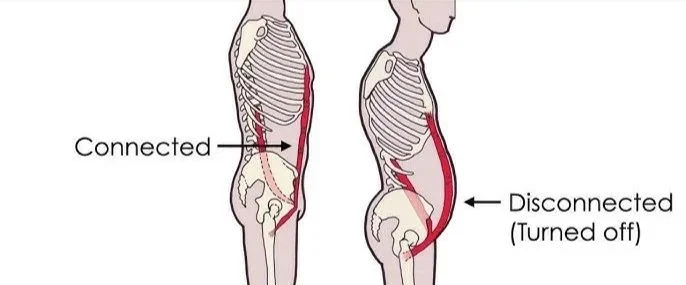
correct core activation
one cue i like to imagine is that there’s a shoelace running from your hip bones up toward your ribs. when you engage your core, it’s like gently pulling that shoelace snug. not yanking it tight, just bringing everything a little closer together so your center feels supported.
another way to think about it is like zipping up a pair of snug jeans. you’re drawing everything in slightly so your torso feels lifted and stable.
not stiff. not clenched. just supported.you might notice core engagement most in poses like plank or boat pose, but it’s actually working throughout your entire practice. in standing poses like warrior II or triangle, your core helps keep your torso from collapsing. in balancing poses, it helps keep you steady. and in the transitions between poses, it helps you move with control instead of just swinging your body from one shape to the next.
this is where yoga starts to feel different. instead of forcing flexibility or chasing depth in a pose, you start to feel how strength and support change the experience entirely. engaging your core should feel subtle. you might think about gently drawing your belly button toward your spine, lifting slightly through the pelvic floor, or wrapping the muscles around your waist like a supportive hug.
and most importantly, you should still be able to breathe. if you’re holding your breath or squeezing everything as tightly as possible, you’ve probably gone a little too far. the goal isn’t tension. the goal is support.because when that support is there, everything else begins to move differently. poses feel steadier. transitions feel smoother. and the practice starts to feel less like something you’re forcing your body into, and more like something your body understands how to do.
and like most things in yoga, it’s not something you master overnight. it’s something you begin to notice little by little, each time you step onto the mat and start paying attention to how your body moves.
-daniela
